
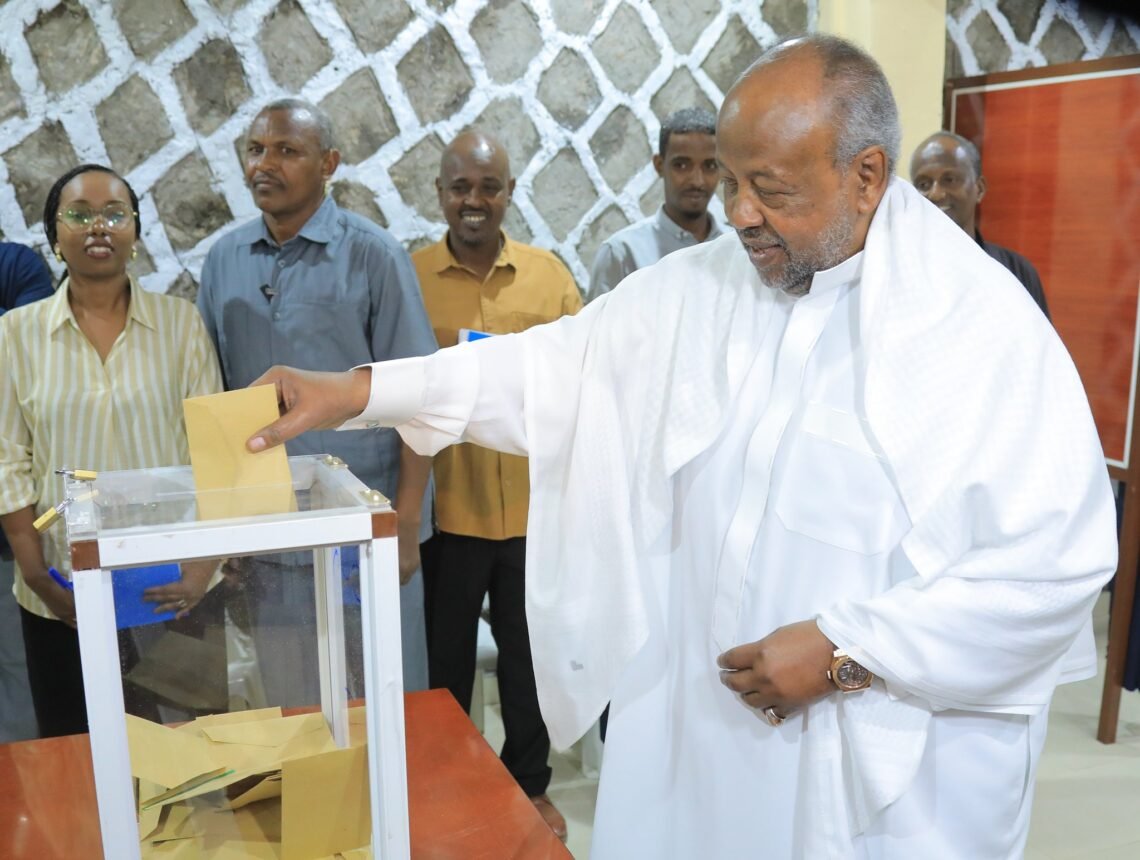
Ismaïl Omar Guelleh has been re-elected as President of Djibouti for a sixth five-year term after securing 97.8% of the vote in Friday’s presidential election, held amid a widespread opposition boycott that observers say rendered the outcome largely predetermined.
According to official figures released by the Ministry of Interior, his sole challenger, Mohamed Farah Samatar, received just 2.2% of the vote in a race limited to two candidates following the withdrawal or boycott of most opposition groups.
Limited Competition and Low Political Pluralism
Around 256,000 voters participated in the election out of a population of approximately 1.2 million, casting ballots across 712 polling stations nationwide, including a significant number in the capital, Djibouti City.
The vote proceeded calmly, with expectations of Guelleh’s victory widespread due to the absence of meaningful competition.
A total of 67 international observers monitored the process, representing organizations such as the African Union, IGAD, and the League of Arab States.
Constitutional Amendment Clears Path for Extended Rule
Guelleh’s candidacy followed a constitutional amendment passed in October 2025, which removed the previous presidential age limit of 75. The amendment was unanimously approved by parliament and formally adopted in November.
While authorities justified the move as necessary for political stability, rights organizations, including the Djiboutian League of Human Rights, criticized it as paving the way for indefinite rule.
Contrasting Campaign Agendas
During the campaign, which began on March 27, Samatar focused on anti-corruption measures, reducing government spending, increasing social investment, and promoting political participation.
In contrast, Guelleh emphasized economic growth, job creation, improved public services, infrastructure development, and maintaining political and security stability.
Over Two Decades in Power
Guelleh has been in office since 1999, making him one of Africa’s longest-serving leaders. Supporters credit him with maintaining stability and leveraging Djibouti’s strategic position near the Bab el-Mandeb Strait.
However, critics accuse his government of restricting political opposition and press freedoms—claims the authorities deny, insisting that elections are conducted within constitutional and legal frameworks.
Strategic Importance and Regional Role
Djibouti occupies a critical location at the entrance of the Red Sea, making it a key hub for international military presence, hosting bases from countries including the United States, France, China, Japan, and Italy.
Mahmoud Ali Youssouf congratulated Guelleh on his re-election, praising the peaceful conduct of the vote and reaffirming Djibouti’s role in promoting regional stability and cooperation.