
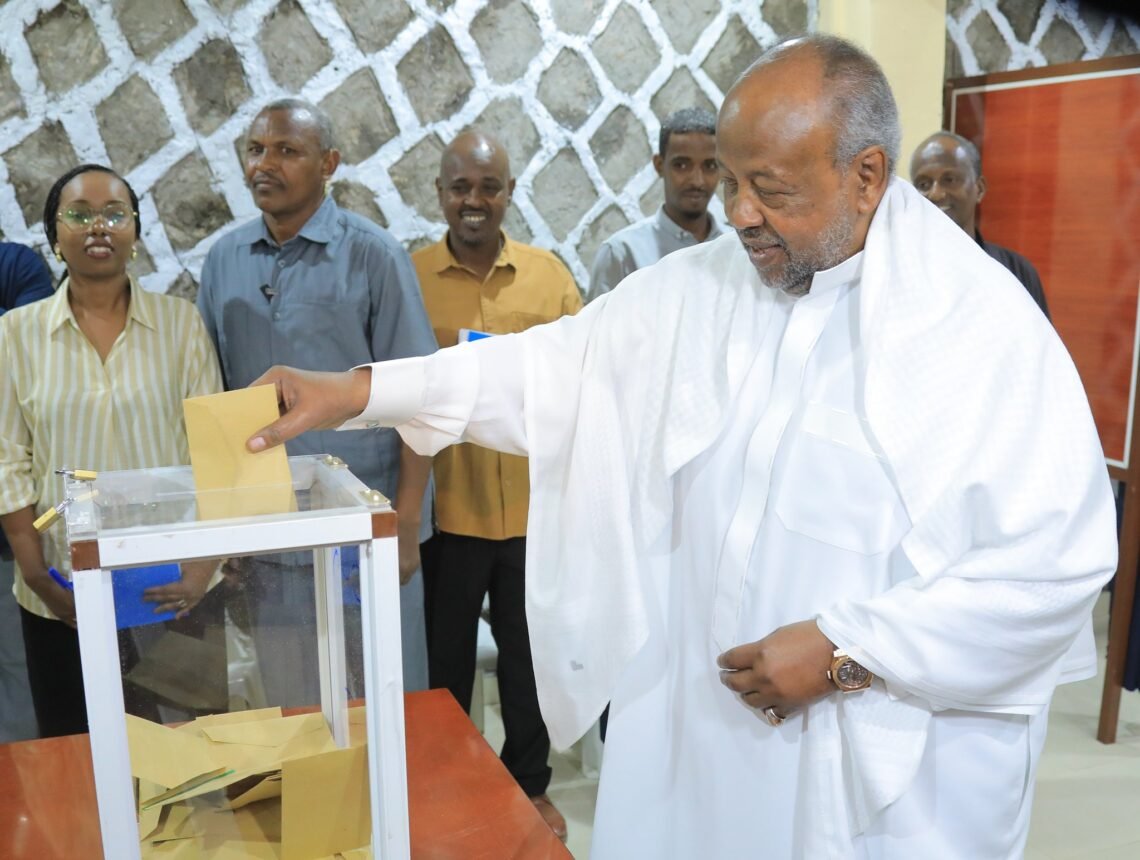
Official results have confirmed the re-election of Djibouti’s president, Ismaïl Omar Guelleh, to a sixth five-year term, after securing 97.8% of the vote in elections held on Friday. The vote took place amid a widespread boycott by opposition parties, which described the outcome as predetermined, according to observers.
According to figures released by Djibouti’s Ministry of Interior, his only challenger, Mohamed Farah Samatar—whose party, the Unified Democratic Centre, has no representation in parliament—received just 2.2% of the vote. The race was limited to two candidates following the exclusion or boycott of most opposition forces.
Voting Process
Voting began on Friday in Djibouti’s ninth presidential election since independence. Around 256,000 voters were called to the polls out of a total population of approximately 1.2 million.
The election was conducted across 712 polling stations nationwide, including more than 160,000 voters in the capital, Djibouti City.
The Ministry of Foreign Affairs also announced the deployment of 67 international observers to monitor the process, representing the African Union, the Intergovernmental Authority on Development (IGAD), the League of Arab States, and the Organisation of Islamic Cooperation.
Voting took place in a calm atmosphere, with early expectations of a victory for the incumbent president, given the lack of real competition and the boycott by major opposition coalitions, according to observers.
Constitutional Amendment Opens the Door to a Sixth Term
Ismaïl Omar Guelleh, aged 78, was originally ineligible to run due to a previous age limit of 75. However, Djibouti’s parliament passed a constitutional amendment in October 2025 removing this restriction.
On October 26, 2025, all 65 members of parliament unanimously approved the bill abolishing the upper age limit for presidential candidates. The amendment was formally ratified on November 2 of the same year.
The Speaker of the National Assembly defended the move as necessary to preserve political stability, while rights organizations—including the Djiboutian League for Human Rights—criticized it as paving the way for the president to remain in power indefinitely.
On November 8, 2025, Guelleh officially announced his candidacy for a sixth term, initiating preparations for elections that would further extend his rule, which began in 1999.
Only Two Candidates in the Race
The Ministry of Interior opened candidate registration between March 2 and March 11. Guelleh ran under the Union for the Presidential Majority coalition, which includes the ruling People’s Rally for Progress party.
On March 10, Mohamed Farah Samatar submitted his candidacy as the sole challenger. A former member of the ruling party, Samatar is considered a relatively low-profile political figure compared to Guelleh, according to reports.
The Constitutional Council approved both candidates on March 12, and on March 18 the Ministry confirmed that the ballot would include only these two names, amid opposition boycotts and the absence of other contenders.
Campaign and Candidates’ Platforms
The official campaign began on March 27. Samatar launched his campaign under the slogan “Another Djibouti is Possible,” focusing on fighting corruption, reducing unnecessary government spending, increasing social expenditure, and promoting political renewal and citizen participation.
On the same day, President Guelleh kicked off his campaign with a mass rally, outlining priorities such as accelerating economic growth, expanding job opportunities, improving public services, and developing infrastructure, while emphasizing the importance of maintaining political and security stability.
Djibouti’s Presidential System
Djibouti’s president is elected through a two-round system for a five-year term. A candidate must secure an absolute majority in the first round to win outright; otherwise, a runoff is held between the top candidates.
Eligibility requirements include exclusive Djiboutian nationality, full civil and political rights, a minimum age of 40, and continuous residence in the country for at least five years.
Guelleh in Power for Over a Quarter Century
Ismaïl Omar Guelleh has been in power since 1999, succeeding his uncle, former president Hassan Gouled Aptidon. He has won every presidential election he has contested, including the 2021 vote in which he received more than 97% of the vote.
Guelleh is one of Africa’s longest-serving leaders. His supporters credit him with maintaining political stability and achieving نسب economic growth in a country with a strategically important location near the Bab el-Mandeb Strait.
However, human rights organizations and opposition figures accuse him of restricting political opposition and limiting press freedom—claims the authorities deny, insisting that elections are conducted within legal and constitutional frameworks.
African Union Congratulates Guelleh
Mahmoud Ali Youssouf, Chairperson of the African Union Commission, congratulated President Guelleh on his re-election, noting the official results announced by Djibouti’s National Independent Electoral Commission.
He also praised the peaceful participation of the Djiboutian people, describing it as evidence of commitment to democratic governance, national cohesion, and stability.
He reaffirmed the importance of Djibouti’s role in promoting peace, security, and regional cooperation in the Horn of Africa, and reiterated the African Union’s commitment to working with member states to achieve the goals of Agenda 2063.
He also commended the African Union’s election observation mission and its leadership, wishing President Guelleh success in his new term.
Djibouti’s Strategic Importance
Djibouti holds a highly strategic position at the entrance to the Red Sea and the Bab el-Mandeb Strait, making it a major international military and maritime hub. The country hosts military bases from several nations, including the United States and France, as well as a military presence from China, Japan, and Italy.
This strategic location is seen as a key factor underpinning the importance of political stability in the country—a point emphasized by Guelleh’s supporters. Meanwhile, the opposition argues that political reform and broader democratic participation are essential for Djibouti’s future.