African Center for Consultancy
Introduction
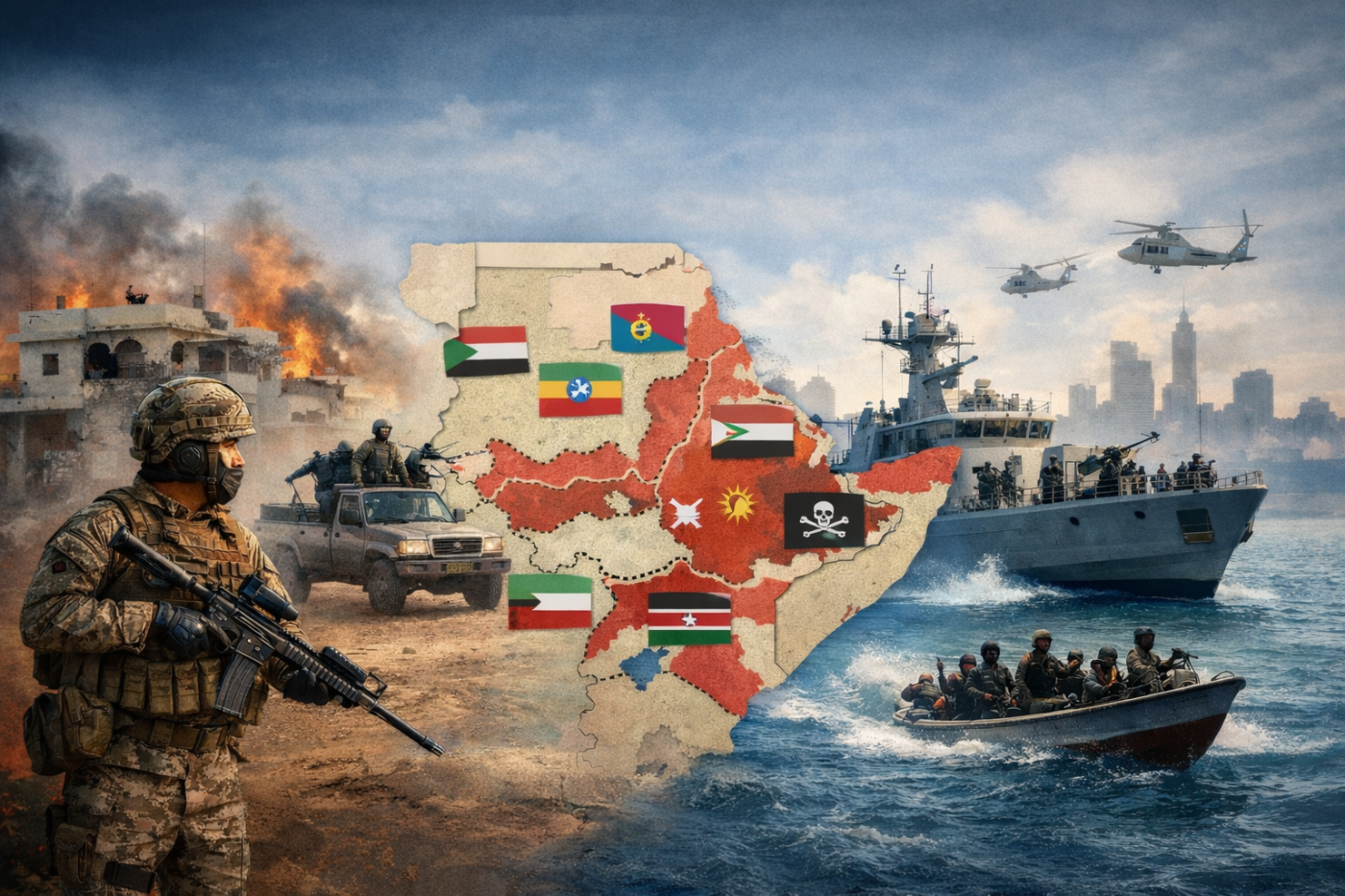
The Horn of Africa, encompassing countries such as Ethiopia, Somalia, Eritrea, Djibouti, as well as Sudan and Kenya, is experiencing persistent security instability. This instability ranges from internal armed conflicts and political fragmentation to cross-border terrorist threats. This strategic region, connecting East Africa to the Red Sea and the Gulf of Aden, serves as a critical hub for international navigation and foreign investments, making its security situation directly influential on regional and global stability.
I. Internal Conflicts and Their Impact on Security
- Ethiopia and the Tigray Conflict
Since the outbreak of the conflict in Ethiopia’s Tigray region in November 2020, the country has faced significant security challenges, including the displacement of millions of civilians and widespread human rights violations. The conflict has led to the spread of armed groups in border areas, increasing regional security threats due to external interventions by neighboring countries. - Somalia: Threats from Youth and Armed Groups
Somalia continues to face threats from the Al-Shabaab terrorist group, which carries out suicide attacks and armed assaults in major cities and rural areas. The group’s operations are not limited to local threats but intersect with cross-border networks involved in arms, drug, and human trafficking, further complicating the security situation in the region. - Eritrea and Its Regional Role
Eritrea, despite its relative internal stability, plays a significant role in regional conflicts, particularly in supporting armed groups or intervening in neighboring disputes such as Tigray and Somalia. This involvement creates persistent tension and increases the likelihood of conflict escalation. - Sudan: Ongoing War Since 2023
Sudan has been embroiled in continuous conflict since 2023, constituting the largest humanitarian crisis in the region, with over ten million displaced persons and a highly fragile security environment.
II. Terrorism and Organized Crime
The Horn of Africa has witnessed increasing activity from transnational terrorist groups, including networks involved in arms, drug, and human trafficking. This activity directly threatens international trade, particularly along the Red Sea and the Gulf of Aden, posing significant maritime security risks as civilian vessels face piracy and armed attacks. In addition, internal armed uprisings and the high degree of political fragility in each country exacerbate security challenges across the Horn of Africa.
III. Regional and International Interventions
The interests of regional and international powers in the Horn of Africa are highly intertwined:
- Saudi Arabia and the UAE: Support specific political and military factions to expand influence in the region.
- Turkey and Qatar: Focus on supporting armed groups or local governments to achieve strategic objectives.
- United States and Europe: Provide limited military and humanitarian support while monitoring terrorist threats, particularly in Somalia and Eritrea.
This complexity of external interventions further complicates the security situation, rendering stabilization efforts fragile and vulnerable.
IV. Humanitarian Crises and Refugees
Ongoing conflicts have resulted in massive waves of displacement, with millions of civilians residing in temporary camps, facing food insecurity and health risks. This environment increases local vulnerability and provides fertile ground for armed groups to recruit youth seeking protection or military engagement.
V. Assessment of Future Security Risks
- Continued armed conflicts may lead to increased regional and international interventions.
- Transnational terrorist activity will persist in threatening maritime security and international trade, with potential escalations in piracy attacks.
- Internal political conflicts in Horn of Africa countries are likely to increase refugee flows and disrupt essential services, exacerbating humanitarian crises.
VI. Strategic Recommendations
- Strengthen security coordination among Horn of Africa countries through regional mechanisms such as IGAD and the African Union to curb the spread of armed groups.
- Support comprehensive development programs to reduce youth recruitment by armed groups, focusing on education and employment in rural areas.
- Monitor transnational terrorist and illicit trade activities across borders while enhancing naval capabilities to combat piracy and trafficking.
- Promote neutral humanitarian interventions to mitigate the effects of conflicts on civilians, with an emphasis on protecting camps and displacement areas.
Conclusion
The Horn of Africa remains a strategically critical region in terms of security, politics, and economics, where local conflicts intersect with complex international and regional interests. Smart crisis management, sustainable humanitarian development funding, and strengthened regional and international cooperation are key factors in mitigating security risks and achieving long-term stability in the region.