
Issued by the African Center for Consultancy
Introduction
Military coups in Africa are no longer exceptional events linked to temporary political deadlock. Over the past two decades, they have evolved into a structural phenomenon reflecting deep distortions in the relationship between the state, society, and the military institution. From West Africa to Central and East Africa, scenes of the overthrow of elected governments or failed coup attempts are repeatedly unfolding within a complex regional and international context marked by crises of legitimacy, economic deterioration, and competition among regional and global powers. This trajectory reproduces what can be described as a “curse of coups,” whereby one coup becomes an inspiring precedent for subsequent attempts, rendering civilian governance fragile in the face of military intervention.
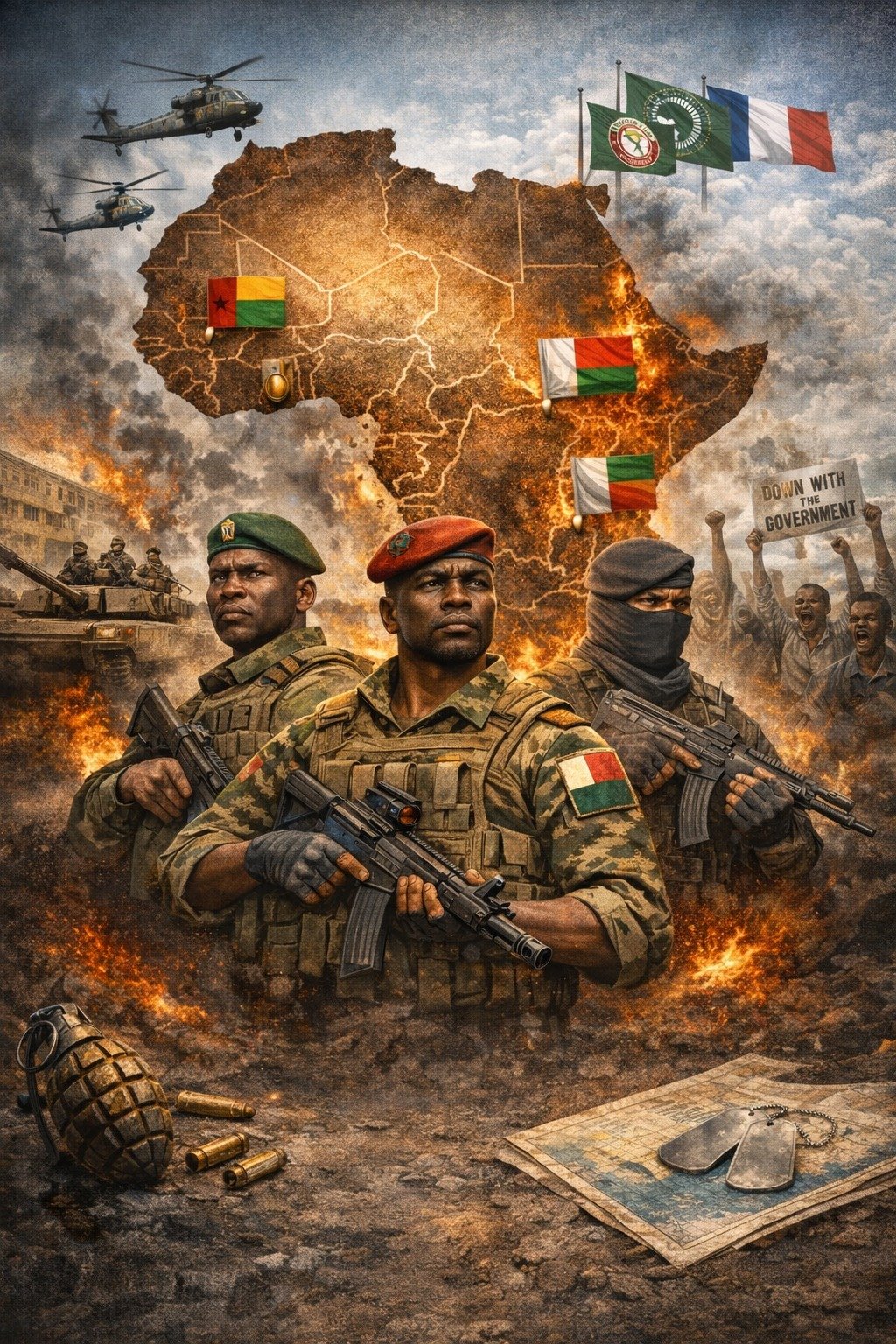
In this context, the final months of 2025 (October, November, and December) witnessed a new wave of coups and coup attempts in several African countries, most notably Madagascar and Guinea-Bissau, alongside a failed coup attempt in Benin, in addition to military movements and either completed or near-completed coups elsewhere. This report aims to provide an in-depth situation assessment of these developments by analyzing their backgrounds, drivers, shared patterns, and regional and international implications.
First: Historical Background and the Coup as a Persistent Phenomenon in Africa
Since the 1960s, the history of the post-independence African state has been closely associated with a long series of military coups, coinciding with weak civilian governance institutions and newly formed armies inheriting political roles that exceeded their constitutional mandates. Despite the wave of democratic transitions in the 1990s, coups did not disappear; rather, they re-emerged in new forms, capitalizing on the failures of democratic experiments themselves to deliver social justice, development, and stability.
Comparative studies indicate that military coups often arise in environments characterized by three main features: weak political legitimacy, economic fragility, and the politicization of the military institution. As these factors recur, coups shift from being shocking events to becoming a “relatively acceptable” tool for some elites or segments of public opinion, especially when presented as an exit from severe crises.
Second: Conceptual and Methodological Framework
This report adopts a multi-level analytical approach combining:
- Political legitimacy perspective, which interprets coups as a direct outcome of the erosion of trust between society and civilian governance.
- Political economy approach, linking economic deterioration, rising unemployment, and widening poverty to the vulnerability of political systems.
- Security–regional approach, focusing on regional interactions, the positions of African organizations, and the influence of international powers in facilitating or thwarting coups.
Third: Coups and Coup Attempts (October–December 2025)
1. Madagascar: Military Coup – October 2025
In mid-October 2025, Madagascar experienced a fully-fledged military coup, representing a highly significant development in Eastern and Southern Africa. Army units, supported by elements of the presidential guard, overthrew the elected president and government and announced the formation of a transitional military council.
The coup occurred amid an escalating political and social crisis marked by sharp economic decline, rising inflation and unemployment, and widespread popular protests led by youth and labor groups accusing the government of economic mismanagement, corruption, and poor governance. Military leaders capitalized on these protests to justify their intervention, presenting the coup as a “response to the will of the people” and a “step to save the state from collapse.”
Institutionally, the coup exposed the fragility of civil–military relations and the failure of security sector reform programs to depoliticize the army. It also demonstrated that the mere existence of elections is insufficient to ensure stability if not accompanied by governmental performance capable of meeting minimum social demands.
Regionally and internationally, the coup was met with condemnations from the African Union and several international partners, and Madagascar’s membership in certain regional mechanisms was suspended, alongside calls for a swift return to constitutional order. However, these reactions once again appeared limited in impact, reinforcing the perception that the cost of a coup in Africa remains lower than the cost of failed civilian governance.
2. Guinea-Bissau: Coup – November 2025
Guinea-Bissau is among the West African states most prone to coups since its independence in 1974. On 26 November 2025, military leaders announced the overthrow of the president and government and the establishment of a transitional military council, citing the need to “save the state” from political chaos and economic collapse.
The coup unfolded amid acute political tensions, intra-elite conflicts, and mutual accusations of corruption, in addition to the army’s entrenched role as a powerful economic and political actor. Despite swift condemnation from the Economic Community of West African States (ECOWAS), the organization’s ability to enforce an immediate return to constitutional order appeared limited due to the lack of effective deterrent tools.
3. Benin: Failed Coup Attempt – December 2025
The failed coup attempt in Benin came as a relative surprise, given the country’s reputation as a model of relative democratic stability in West Africa. In early December 2025, a small group of military personnel attempted to seize key sovereign institutions, but the attempt was quickly thwarted thanks to the cohesion of military leadership, regional support, and security coordination with neighboring states—particularly Nigeria. Some sources also point to French military and intelligence intervention to prevent the coup’s success.
This attempt reveals a latent fragility within Benin’s political system, linked to controversial constitutional amendments and internal political polarization, indicating that apparent stability does not necessarily equate to immunity from coup risks.
4. Other Cases and Regional Movements
Beyond Madagascar, Guinea-Bissau, and Benin, several African states experienced mutinies, limited military movements, or threats of coups that did not fully materialize during the same period. These developments point to a charged regional environment in which the appetite of certain military actors for political intervention is growing.
Fourth: Shared Patterns and Drivers of Coups
Analysis of the various cases reveals several common patterns:
- Erosion of political legitimacy and loss of public trust in governments.
- Acute economic crises weakening the state’s capacity to respond to citizens’ demands.
- Politicization of the military and its transformation into an economic and political actor.
- Dense international and regional interventions with a destructive negative impact.
- The contagion effect of coups, whereby the success of a coup in one country encourages similar attempts elsewhere.
Fifth: Regional and International Impacts
The wave of coups has profound implications for Africa’s security and stability, including:
- Undermining democratic transition processes.
- Declining foreign investment and international assistance.
- Complicating regional cooperation in counterterrorism and combating transnational crime.
- Deepening external powers’ intervention in African affairs.
Sixth: Future Scenarios
Three main scenarios can be envisaged:
- The continuation of the coup wave amid the absence of genuine reforms.
- Gradual containment through regional and international pressure and limited reforms.
- A positive structural transformation if comprehensive political and economic reforms succeed.
Conclusion
The coups and coup attempts witnessed in Africa during the final months of 2025 confirm that the continent remains captive to deep structural challenges. Breaking the cycle of the “curse of coups” is impossible without addressing the root causes of the crisis and building states capable of achieving legitimacy, development, and the rule of law.
References
African Union (2025) Communiqué of the Peace and Security Council on the attempted coup in Benin, 7 December 2025. Available at:
https://au.int/sites/default/files/pressreleases/45743-pr-Eng_Draft_CP_Communique_-_Attempted_Coup_in_Benin_-_7_December_2025.pdf
(Accessed: 16 December 2025).
African Union (2025) African Union suspends Madagascar following military takeover. Abuja Press. Available at:
https://www.abujapress.com/2025/10/african-union-suspends-madagascar-after.html
(Accessed: 16 December 2025).
Africanews (2025) ‘ECOWAS rejects Guinea-Bissau military transition plan, warns of sanctions’, Africanews, 15 December. Available at:
https://www.africanews.com/2025/12/15/ecowas-rejects-guinea-bissau-military-transition-plan-warns-of-sanctions/
(Accessed: 16 December 2025).
Africanews (2025) ‘West African troops support Benin government following failed coup’, Africanews, 13 December. Available at:
https://www.africanews.com/2025/12/13/west-african-troops-supporting-benin-government-following-failed-coup/
(Accessed: 16 December 2025).
Al Jazeera (2025) Political instability and coups in West Africa. Available at:
https://www.aljazeera.com
(Accessed: 16 December 2025).
Al-Ain News (2025) ‘مدغشقر: انقلاب عسكري وسط احتجاجات وأزمة اقتصادية’, العين الإخبارية, October. Available at:
https://al-ain.com/article/1760251717
(Accessed: 16 December 2025).
Associated Press (AP) (2025) ‘Wave of coups raises fears of instability across Africa’, AP News, November. Available at:
https://apnews.com/article/c6f6a9dc336c774ba8190e73f43158b6
(Accessed: 16 December 2025).
Benin Web TV (2025) ‘Putsch en Guinée-Bissau: la CEDEAO menace de sanctions’, Benin Web TV, November. Available at:
https://beninwebtv.bj/en/putsch-en-guinee-bissau-la-cedeao-prend-clairement-position-et-menace/
(Accessed: 16 December 2025).
Channels Television (2025) ‘10 coups in five years: African countries hit by military takeovers’, Channels TV, 28 November. Available at:
https://www.channelstv.com/2025/11/28/10-coups-in-five-years-african-countries-hit-by-military-takeovers-full-list/
(Accessed: 16 December 2025).
Deutsche Tageszeitung (2025) ‘Army colonel set to be sworn in as Madagascar president’, Deutsche Tageszeitung, October. Available at:
https://www.deutschetageszeitung.de/en/Politics/718513-army-colonel-set-to-be-sworn-in-as-madagascar-president.html
(Accessed: 16 December 2025).
ECOWAS (2025) Communiqués on unconstitutional changes of government in West Africa. Abuja: ECOWAS Commission. Available at:
https://ecowas.int
(Accessed: 16 December 2025).
Le Monde (2025) Mbembe, A. ‘We will see more coups d’état in Africa’, Le Monde Afrique, 11 December. Available at:
https://www.lemonde.fr/en/le-monde-africa/article/2025/12/11/achille-mbembe-philosopher-we-will-see-more-coups-d-etat-in-africa_6748370_124.html
(Accessed: 16 December 2025).
Project Syndicate (2025) ‘Why coups persist in Africa’, Project Syndicate, November. Available at:
https://www.project-syndicate.org
(Accessed: 16 December 2025).
Reuters (2025) ‘West African bloc rejects Guinea-Bissau’s military transition plan’, Reuters, 14 December. Available at:
https://www.reuters.com/world/africa/west-african-bloc-rejects-guinea-bissaus-military-transition-plan-2025-12-14/
(Accessed: 16 December 2025).
Reuters (2025) ‘Guinea-Bissau’s long history of coups and political instability’, Reuters, 27 November. Available at:
https://www.reuters.com/world/africa/guinea-bissaus-history-coups-instability-2025-11-27/
(Accessed: 16 December 2025).
Reuters (2025) ‘France provided logistical support as Benin thwarted coup, Elysee says’, Reuters, 9 December. Available at:
https://www.reuters.com/world/africa/france-provided-logistical-support-benin-thwart-coup-elysee-says-2025-12-09/
(Accessed: 16 December 2025).
Reuters (2025) ‘Benin security forces foil attempted coup’, Reuters Video, December. Available at:
https://www.reuters.com/video/watch/idRW798707122025RP1/
(Accessed: 16 December 2025).
Wikipedia (2025) 2025 Malagasy coup d’état. Available at:
https://en.wikipedia.org/wiki/2025_Malagasy_coup_d%27%C3%A9tat
(Accessed: 16 December 2025).
Xinhua News Agency (2025) ‘Madagascar military leader sworn in following coup’, Xinhua, 17 October. Available at:
https://english.news.cn/africa/20251017/189bfd85702848c784214c330651b901/c.html
(Accessed: 16 December 2025).