
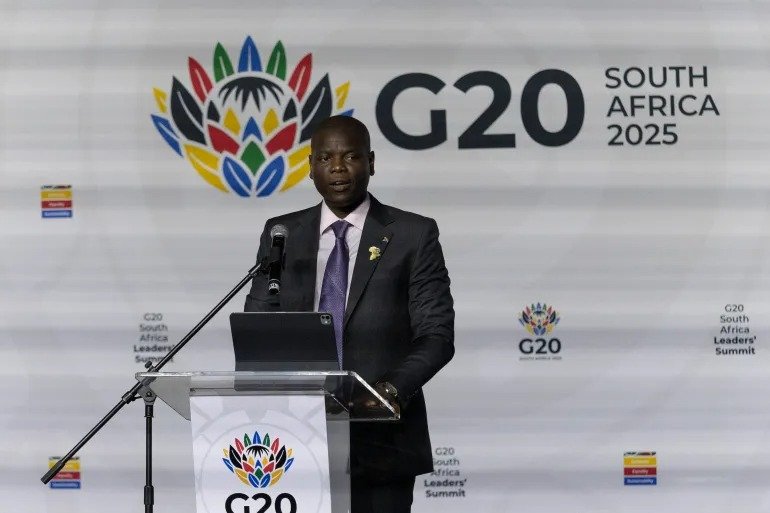
South Africa’s Minister of International Relations and Cooperation, Ronald Lamola, asserted on Saturday that his country cannot be excluded from the G20, emphasizing that no member state has the authority to make such a unilateral decision. His remarks came in response to U.S. Secretary of State Marco Rubio’s announcement that he intends to invite Poland to the 2026 G20 summit in Miami instead of South Africa.
In an official statement, Lamola said South Africa is “a founding member of the G20, and its presence is based on full, indisputable legitimacy,” rejecting U.S. accusations of mismanagement, political polarization, and corruption. He added that South Africa’s presidency of the group is based on strengthening the participation of African and Global South countries as “equal partners” within the international platform.
Despite U.S. criticism, Lamola stressed that South Africa remains open to dialogue with Washington.
Rubio had accused the South African government of economic mismanagement and adopting “anti-American” policies, claiming that what he described as “discrimination against whites” contributed to economic decline and the country’s exit from the list of the world’s top 20 industrial economies.
He also announced that the United States would not invite South Africa to G20 meetings during its presidency, saying Poland would take its place “where it rightfully belongs.”
These remarks come amid ongoing tensions between Washington and Pretoria, especially after the United States skipped the latest G20 summit in South Africa — a move President Donald Trump justified by citing “violence against whites” in the country, allegations the South African government has repeatedly denied.
Media reports indicate that whites, who make up about 8% of the population, still own more than 70% of the land, while Black South Africans — around 80% of the population — own only about 4%. The 2024 Expropriation Act signed by President Cyril Ramaphosa has stirred controversy, as it allows land expropriation without compensation to accelerate redistribution.