
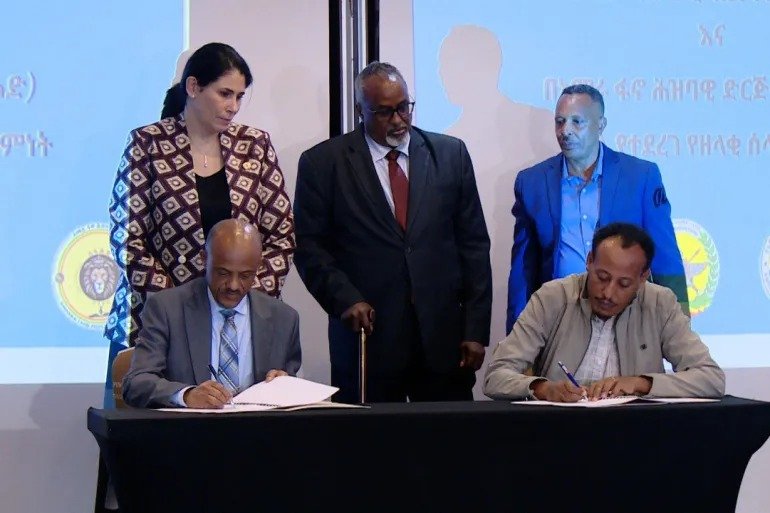
The Amhara regional government and the Fano militia have concluded more than two years of military confrontation by signing a historic peace agreement — the first between the two sides — following lengthy negotiations mediated by the African Union and IGAD.
The agreement was signed in the presence of AU Commission deputy chair Salma Haddadi and IGAD deputy secretary-general Mohamed Abdi. The regional government was represented by Governor Ariga Kibede, while Captain Masresha Seteng signed on behalf of the Fano militia.
Haddadi said the agreement marks “a new chapter” for the region, emphasizing that the peace process remains open to all factions willing to join. She stressed Africa’s need to “silence the guns and strengthen dialogue,” describing the deal as part of a continental vision for resolving internal conflicts.
IGAD’s Mohamed Abdi said the agreement represents significant progress in a region long riddled with recurring conflicts, but warned that the real challenge lies in implementing its provisions. He urged other factions to choose dialogue.
Governor Kibede said the negotiations required multiple rounds before reaching a comprehensive agreement, emphasizing that the war brought only loss and suffering to Amhara’s population. He called on other armed groups to lay down their weapons and join the peace process, describing the deal as a step toward restoring stability after years of turmoil.
Fano representative Masresha Seteng said the decision to sign came from a growing conviction that war was no longer a viable option, and that political solutions offered the best path forward. He stressed that choosing dialogue “is not a political defeat but wisdom,” declaring that Fano considers the fighting over and is ready to work with the government to fulfill the aspirations of the region’s residents.
Despite its armed influence, Fano lacks unified leadership and a cohesive political structure, making its relationships with the regional government and the federal government complex and often tense.
The Amhara region holds significant geographic and strategic importance, bordering Eritrea and Sudan, as well as the regions of Tigray, Afar, Oromia, and Benishangul-Gumuz—making it central to Ethiopia’s security and political dynamics.