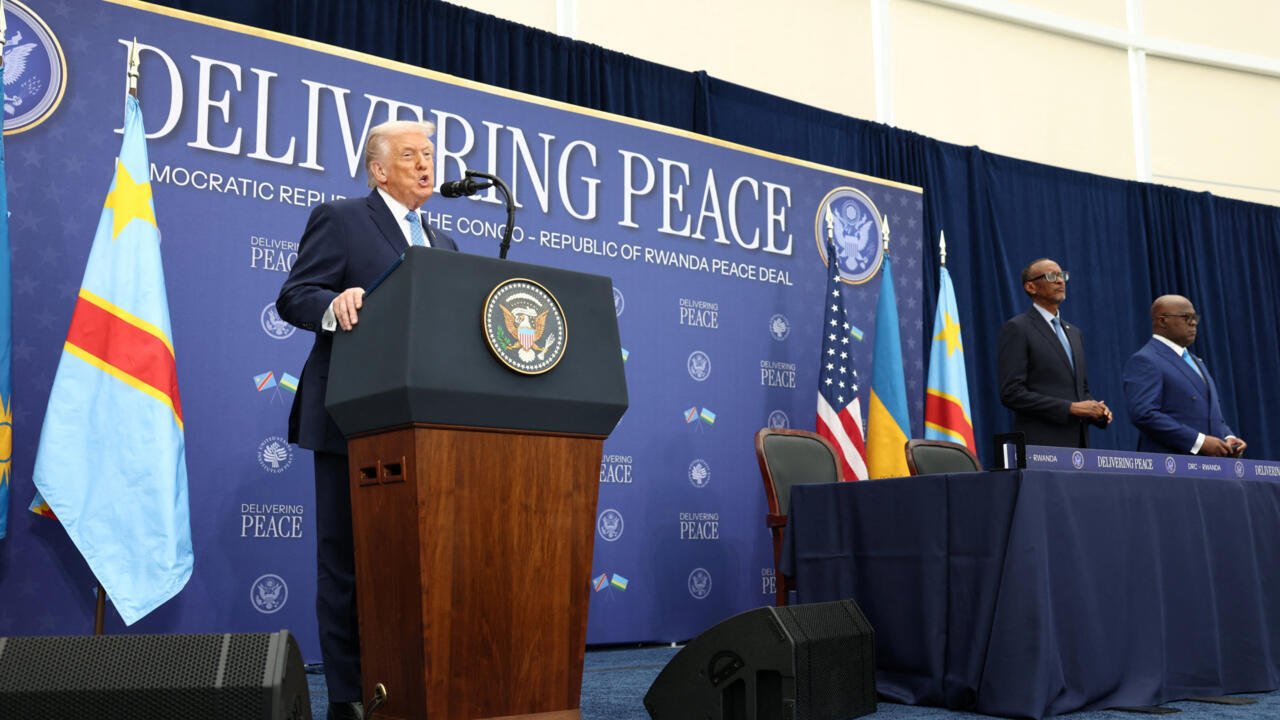
The U.S. capital Washington witnessed the signing of a peace agreement between the Democratic Republic of the Congo and Rwanda, under the auspices of U.S. President Donald Trump. The move aims to end decades of armed conflict in eastern Congo, despite ongoing fighting on the ground that has raised questions about the viability of the deal.
The signing took place at a Trump-branded institute in the presence of Rwandan President Paul Kagame and his Congolese counterpart Félix Tshisekedi. During the ceremony, Trump described the agreement as a “great miracle,” stressing that it opens the door to expanded cooperation, including agreements on the countries’ critical minerals, at a time when global competition over Congo’s cobalt and coltan is intensifying.
“You spent years fighting, and now you will spend years cooperating and benefiting economically… just like all other nations,” Trump told the two leaders, before announcing that the United States would pursue extensive investment in rare earth minerals.
Kagame and Tshisekedi, however, struck a more measured tone. Kagame acknowledged that “there will undoubtedly be obstacles,” while Tshisekedi described the deal as “the beginning of a new path that requires a lot of hard work.” Their remarks came amid continued attacks by the M23 armed group, which the United Nations says is backed by Rwanda, and which has been making military advances in several areas of eastern Congo.
Trump boasted that the conflict in Congo was among “eight wars” he claimed to have ended since returning to the White House in 2025, openly expressing his desire to win the Nobel Peace Prize. He linked the agreement to efforts to secure a share for American companies in exploiting Congo’s vast mineral wealth, saying: “We will extract the rare earth minerals… and everyone will make a lot of money.”
In contrast, Congolese presidential spokesperson Tina Salama said the agreement includes peace, economic integration, and a strategic partnership with the United States, but firmly rejected the idea of “peace in exchange for minerals,” affirming Kinshasa’s sovereignty over its resources. She also did not rule out discussions on other matters, including the deportation of American migrants, as part of the broader understandings.
The new agreement comes in a region dominated by violence for three decades, which intensified after M23’s resurgence in 2021 and its capture of major cities such as Goma and Bukavu, despite a series of previous agreements that were all violated. The success of the latest deal therefore hinges on de-escalation on the ground and activation of a political process.