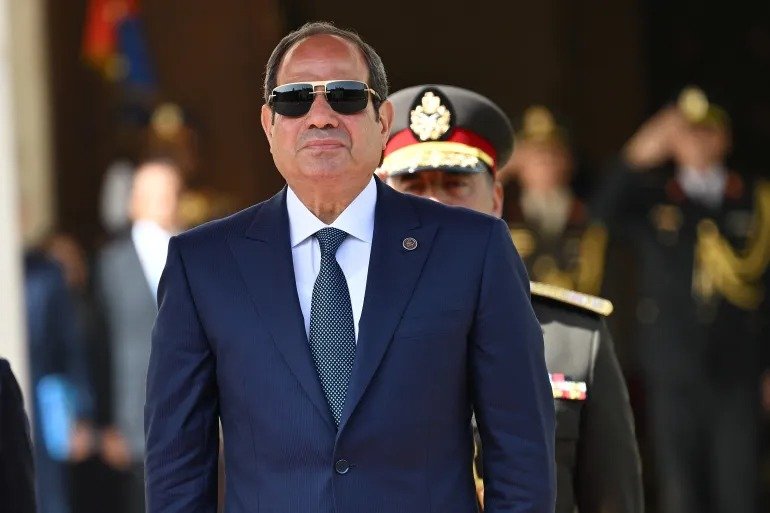
Egyptian President Abdel Fattah El-Sisi on Sunday accused Ethiopia of causing harm to the downstream countries, Egypt and Sudan, through the Grand Ethiopian Renaissance Dam (GERD). He called for international and African action to reach a legally binding agreement on the dam’s operation and filling, stressing that Egypt “will not stand idly by.”
In a recorded speech delivered at the opening session of the 8th Cairo Water Week, El-Sisi said that for the past 14 years Egypt has pursued an “honest, wise, and prudent” diplomatic path in an effort to reach a legally binding agreement on the Ethiopian dam that takes into account the interests of all parties.
He added that Cairo has, over the years, presented “sound technical alternatives that meet Ethiopia’s declared development goals while safeguarding the interests of the downstream countries.” However, he said, these efforts “have been met with obstinacy that can only be explained by a lack of political will and a desire to impose a fait accompli, driven by narrow political calculations and false claims of exclusive sovereignty over the Nile.”
El-Sisi affirmed that the Nile River is “a shared property of all its riparian states and a collective resource that cannot be monopolized.” He noted that “Ethiopia, through its unregulated management of the dam in recent days, has caused harm to the downstream countries by releasing irregular water flows without prior notification or coordination,” resulting in the flooding of lands and homes in both Egypt and Sudan.
The president called on the international community — and Africa in particular — to confront such “reckless actions by the Ethiopian administration” and to ensure the regulation of water releases from the dam during drought and flood periods within the framework of a legally binding agreement sought by the two downstream nations.
He stressed that “Egypt’s choice of diplomacy and recourse to international institutions, foremost among them the United Nations, has never been a sign of weakness or retreat, but rather an expression of the strength of its position and the maturity of its vision.” He reiterated that “Egypt will not stand idly by and will take all necessary measures to protect its interests and water security.”
Earlier, on October 3, Egypt’s Ministry of Irrigation accused Ethiopia of taking “reckless and irresponsible actions” in managing the dam, saying such actions “have caused harm to Sudan and pose a direct threat to Egyptian land and lives.”
Several areas in Sudan and Egypt have recently experienced flooding due to rising water levels in the Nile, amid the continued deadlock over an agreement on the filling and operation of the dam, whose construction began in 2011.
Egypt and Sudan are demanding a legally binding trilateral agreement before the remaining stages of filling and operation proceed, while Ethiopia maintains that it does not intend to harm any country’s interests — a dispute that has left negotiations suspended since 2024, after a brief resumption in 2023.